Every college in India,
made findable.
India publishes its college data across half a dozen official registers, none of which agree with each other and several of which have gone stale. KforCollege turns that into one directory a student can actually search — and one search engines can actually crawl.
Visit the live siteFigures read from the production database on 21 September 2026.
A directory that had to be trusted before it could be useful
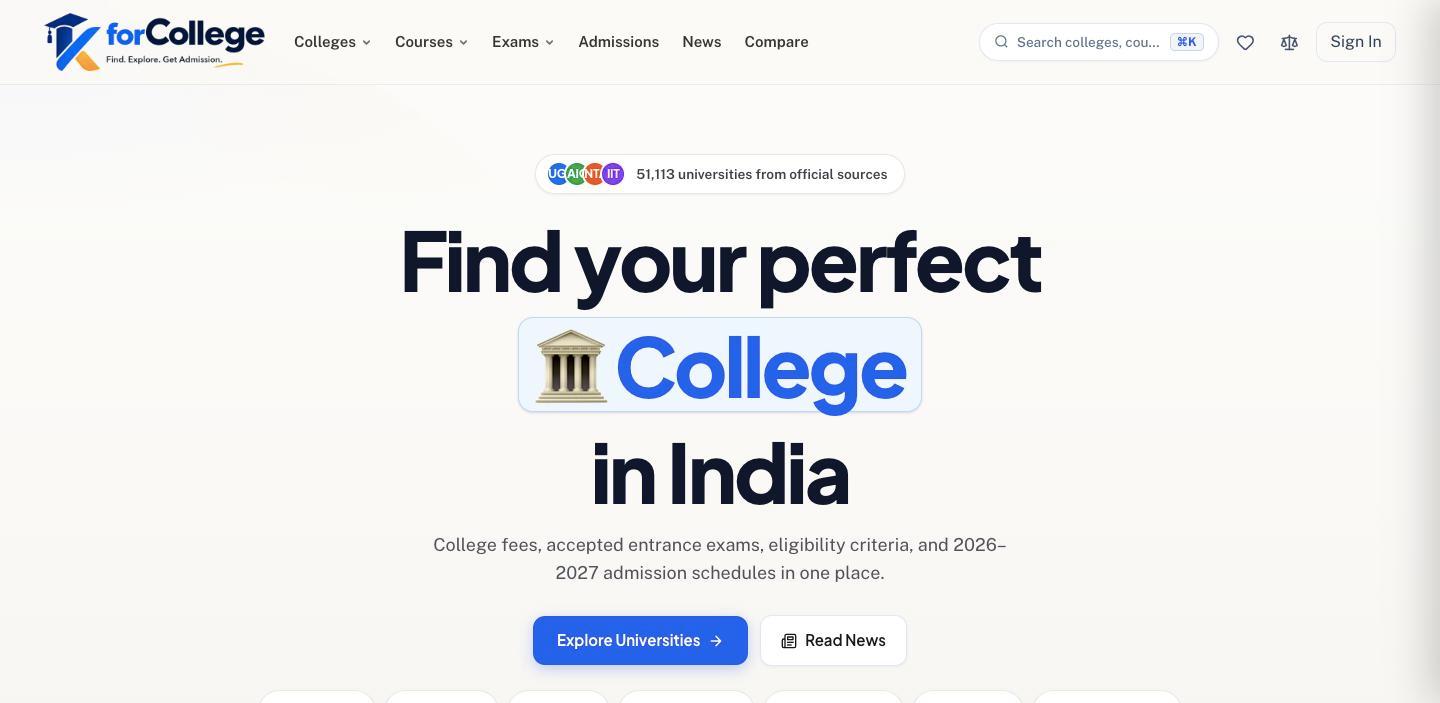
KforCollege helps students in India choose where to study. The promise is simple — fees, entrance exams, eligibility and admission dates for every institution, checked and kept current — and the difficulty is entirely in the word every.
A student comparing two colleges is making one of the larger financial decisions of their life. That sets the engineering constraint for the whole project: it is better to show nothing than to show a plausible number nobody can source.
Official data is public, scattered, and frequently out of date
The AISHE directory, the UGC and NAAC registers and the institutions themselves each publish a different slice, at a different moment, and they disagree with each other more often than you would expect. Deciding which one to believe — record by record — is the work. An entry that was correct three years ago still reads as authoritative today, and only a person checking it against the others will notice.
Five decisions the rest of the system rests on
Decide which sources deserve to be trusted
India's college data is public but scattered across the AISHE directory, the UGC and NAAC registers, and the institutions' own publications. The first job was not engineering. It was reading them - working out how current each register is, where they contradict each other, and which one wins when they do. An official list that has quietly gone stale is worse than no list, because it still reads as authoritative.
Nothing is published on one source alone
Every record is held against the official document it came from and checked before it goes anywhere near the live site. 149,941 have been through that check so far. The rule is simple and it is never bent: if a fact cannot be traced back to a named source, it does not appear on the page.
Match on identity, never on resemblance
Merging sources means deciding when two records are the same college. Name similarity is not good enough at this scale: an early attempt matched a school of psychology to an unrelated research institute, and one matching pass created 42 duplicate colleges in a day. Records are joined on identity - a government AISHE code, or a college's own website domain, and only when that domain belongs to exactly one college on each side.
Give every page a real address
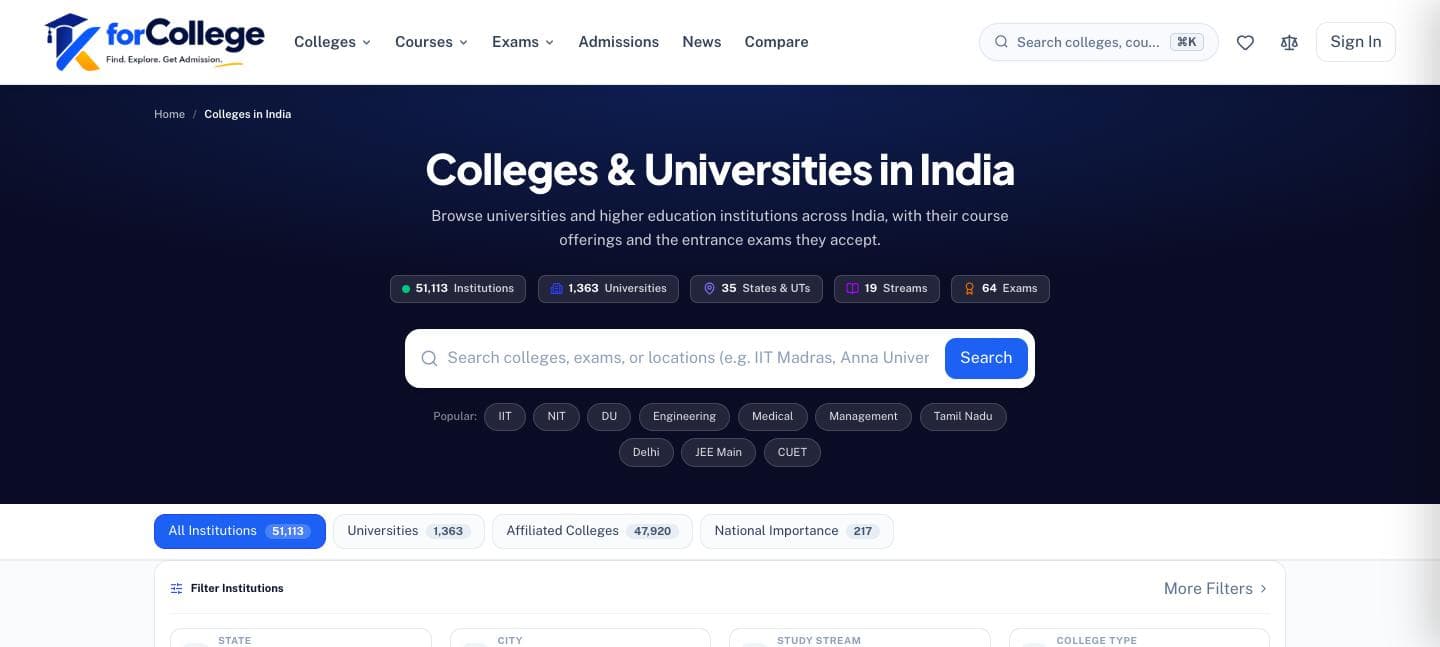
A directory earns its traffic from pages that exist, not filters that hide behind a query string. Every city, stream and level combination worth finding is a route of its own - 26,607 of them - which is why the site now has around 94,000 indexable URLs in 96 sitemaps rather than one page with a search box.
Make 51,113 pages fast enough to crawl
Search engines reduce crawl rate on slow sites, so performance is not a finishing touch here - it decides how much of the directory gets seen. Landing pages are pre-rendered at build, the rest revalidate on a schedule, and the cache is warmed nightly. Pages serve in under a second.
Published only once the record earns it
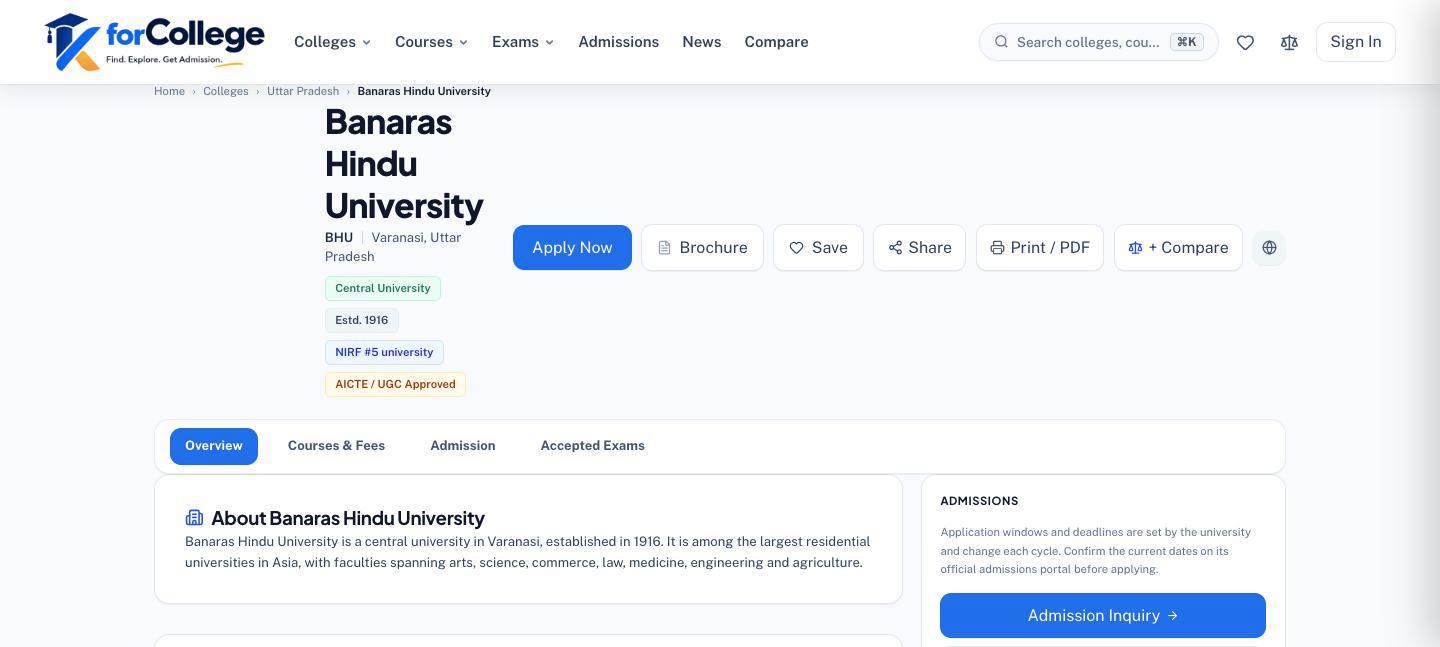
A record only goes live once it clears a publish bar. The thousand-odd colleges held back are not a backlog to be cleared by lowering the standard — they are the standard working.
What it looks like in use
Four problems that only appear at this scale
Official sources go stale
Government directories are authoritative and frequently out of date. We hold a college's website, check whether it still answers, and record the HTTP status rather than a yes/no - a 403 means the site is blocking crawlers, a 404 means it has moved, and treating those the same means abandoning institutions that were never gone.
The same college, written six ways
"Hansraj College" and "Hans Raj College" are one institution. So are "SHUATS" and "Sam Higginbottom Institute". Indian college names vary by spacing, apostrophe, transliteration and acronym more than any single rule absorbs, which is why matching leans on identifiers and records how each pairing was decided so it stays reversible.
Shared domains hide behind clean data
hte.rajasthan.gov.in is listed as the website for 304 different colleges, because it is a state directory rather than a campus site. amity.edu covers 21 campuses. A domain match is only safe where the domain belongs to exactly one college on both sides - a rule that costs real matches and prevents filing one college's fees against twenty others.
Empty is not the same as unknown
A missing fee, an unnamed cutoff and a course nobody has confirmed all render as nothing at all rather than as a zero or a guess. The site states what is held and stays quiet about the rest, because a directory that invents a plausible number is unusable for the one decision it exists to support.
Mainstream tools, chosen so the work stays maintainable
Source, infrastructure config and deployment pipeline sit on the client's own accounts. Nothing is locked to us.
Have a dataset nobody has managed to make usable?
That is most of what this project was. Tell us what you are working with and we will say honestly whether it is tractable.
Book a discovery call