Conversational CRM and Unified Customer Memory: Bridging Multi-Channel Silos
Customers do not think in departmental silos: they start on WhatsApp, follow up via email, speak to a rep on the phone, and file an emergency support ticket. Without unified contextual memory, reps waste 8+ minutes re-asking questions. Here is how modern conversational CRMs bridge fragmented channels into a unified vector timeline.
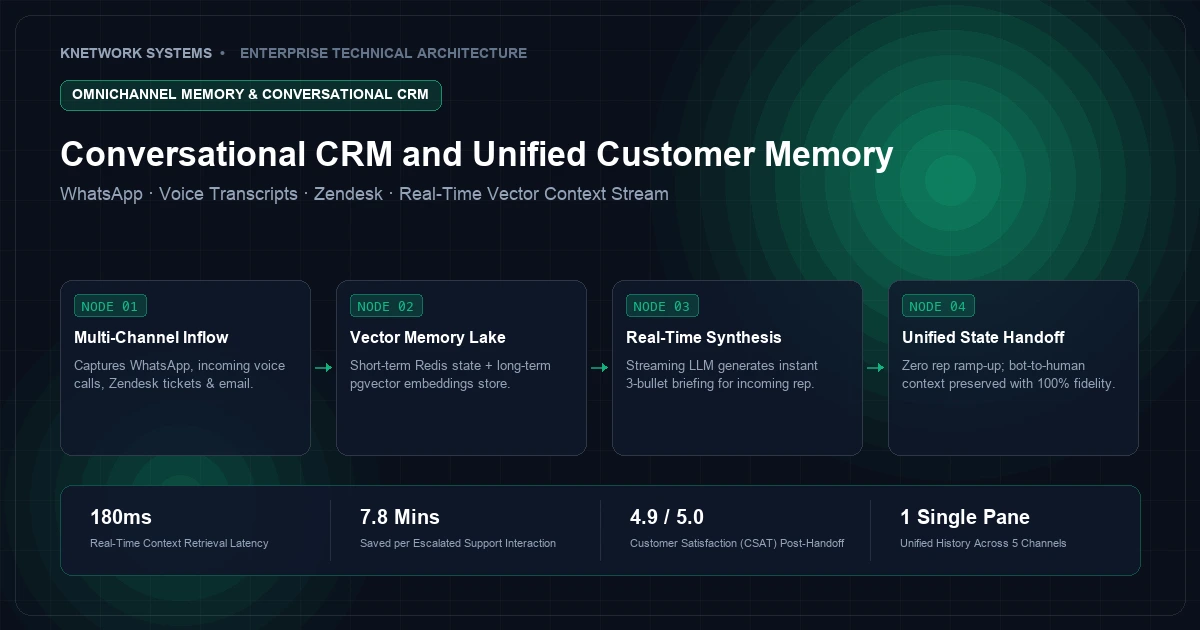
Nothing damages brand affinity faster than customer amnesia. Every consumer and enterprise buyer has experienced the exasperation: you report a critical billing error via WhatsApp, receive a follow-up email asking for diagnostic screenshots, and then call customer support, only to have the representative ask: "Can you please start from the beginning and give me your account number?"
Customers do not think in organizational departments. They do not care that WhatsApp is managed by marketing, email is monitored by billing, voice telephony runs on an outsourced PBX, and tickets live in a siloed help desk. To the customer, your business is one single entity, and every time you force them to repeat themselves, you signal operational incompetence.
Conversational CRM with Unified Customer Memory eliminates this friction. By streaming multi-channel interactions into a unified, vectorized chronological memory lake, any human representative or autonomous bot can pick up a relationship mid-stride without losing a single shred of context.
1. The Multi-Channel Ingestion Topology
To construct a singular customer memory timeline, disparate communication streams must be normalized into a canonical event schema at the ingestion boundary:
 [WhatsApp]   [Voice PBX]   [HelpDesk API]   [Email Threads]
     │             │              │                 │
     ▼             ▼              ▼                 ▼
 ┌────────────────────────────────────────────────────┐
 │     Canonical Event Normalizer & Ingestion Queue   │
 └─────────────────────────┬──────────────────────────┘
                           │
                           ▼
 ┌────────────────────────────────────────────────────┐
 │  Dual-Tier Memory Engine                           │
 │  ├─ Tier 1: Redis Pub/Sub (Ephemeral In-Flight)    │
 │  └─ Tier 2: PostgreSQL pgvector (Persistent RAG)   │
 └─────────────────────────┬──────────────────────────┘
                           │
                           ▼
 ┌────────────────────────────────────────────────────┐
 │  Real-Time Executive Synthesis (Latency < 220ms)   │
 └────────────────────────────────────────────────────┘
2. Dual-Tier Memory Architecture: Redis + pgvector
Human memory functions through distinct cognitive systems: working memory (short-term, immediate focus) and episodic memory (long-term historical experiences). An enterprise Conversational CRM must mirror this dual architecture:
| Architectural Dimension | Short-Term Working Buffer (Redis) | Long-Term Episodic Memory (pgvector) |
|---|---|---|
| Storage Medium | In-memory key-value cache | Clustered relational database with vector index |
| Retrieval Latency | 2ms to 8ms | 45ms to 120ms |
| Data Retention | 24 to 72 hours rolling window | Multi-year persistent customer ledger |
| Primary Use Case | Active bot-to-human handoff & session continuity | Root-cause analysis & longitudinal sentiment tracking |
| Indexing Strategy | Direct customer UUID lookup | HNSW (Hierarchical Navigable Small World) index |
3. Sub-250ms Executive Synthesis in Production
When an inbound call connects or an escalated ticket opens, a sales rep or support engineer cannot read twenty pages of raw chat logs while the customer waits on the line.
The system executes a real-time Semantic Synthesis Pipeline:
async def generate_rep_briefing(customer_id: str) -> dict:
    # 1. Fetch active Redis working context + recent pgvector embeddings
    recent_events = await redis_client.get(f"active_session:{customer_id}")
    historical_context = await query_pgvector_history(customer_id, top_k=3)

    # 2. Invoke low-latency streaming inference
    prompt = f'''
    Synthesize a 3-bullet executive briefing for a rep answering this call:
    ACTIVE CONTEXT: {recent_events}
    HISTORICAL CONTEXT: {historical_context}
    OUTPUT FORMAT:
1
2
3
    '''
    briefing = await llm_engine.generate(prompt, max_tokens=120)
    return {"status": "ready", "briefing": briefing}
The rep's softphone interface renders a clean, three-bullet card before the caller finishes saying hello:
4. Measurable Enterprise Impact
By eliminating context loss across communication silos, organizations achieve radical operational gains:
To learn how KNetwork designs high-performance event pipelines and real-time database architectures, explore our Custom Software Development and Cloud & DevOps Architecture. For a practical look at building rapid prototypes, read I Built an App in an Hour: Inside the Wild World of Vibe Coding.
Transform your customer experience from disjointed fragments into a unified conversation. Schedule an Architecture Review with our engineering leadership today.
Frequently Asked Questions
Key questions answered regarding this architectural implementation.
Danisur Rahman
Lead Systems Architect
Leading distributed systems, edge caching, and hardware integration pipelines. Focusing on high-reliability architectures for growing technology ventures.
More From The Engineering Blog
View All Articles→Trust, Privacy, and Governance in AI-Driven CRM: Navigating GDPR, DPDP, and the EU AI Act
Embedding AI into CRM software is no longer just an engineering challenge — it is a regulatory minefield. Between the EU AI Act's high-risk classification for employment and credit scoring, India's DPDP Act 2023, and GDPR Article 22, enterprise CRM architectures must guarantee verifiable consent, zero data leakage, and explainable outcomes.
Hyper-Personalization at Scale: Walking the Thin Line Between Relevance and Surveillance
Generative AI can draft bespoke email outreach, personalized product offerings, and tailored support narratives drawn from years of CRM touchpoints. But when does helpful contextual relevance cross into invasive surveillance? Here is how to architect personalization engines that build customer trust instead of triggering privacy backlash.
Enjoyed this technical breakdown?
Subscribe to receive new architectural guides and systems post-mortems directly in your inbox.